

If you have ever sat staring at the end of a formal letter, unsure whether to write “Yours faithfully” or “Yours sincerely”, you are not alone. It is one of those small questions that causes a surprising amount of worry — especially when the letter is a job application or a formal complaint, and getting it wrong feels like it might count against you. The good news is that the question of faithfully or yours sincerely has a simple answer, and once you know the rule, you will never have to guess again.
The rule comes down to one thing: the greeting at the top of your letter. If you have used the reader’s name — “Dear Mr Smith”, “Dear Ms Patel”, “Dear Dr Ahmed” — you close with “Yours sincerely”. If you have not used a name, and your letter begins “Dear Sir or Madam”, you close with “Yours faithfully”. That is the whole rule in traditional British English, and it has been the standard for well over a hundred years. At GrammarSay, we get asked about this pair more than almost any other closing, so this guide covers the rule in full: what each closing means, when to use each one, how American usage differs, the capitalisation and punctuation details that people get wrong, the modern email alternatives, and full example sign-offs for a cover letter, a complaint letter and an enquiry email.
Faithfully or Yours Sincerely: The Quick Answer
The short answer to faithfully or yours sincerely is this: use “Yours sincerely” when you know the recipient’s name, and “Yours faithfully” when you do not.
- Yours sincerely — use it after a greeting that names the reader: “Dear Mr Smith”, “Dear Ms Patel”, “Dear Dr Ahmed”.
- Yours faithfully — use it after a general greeting with no name: “Dear Sir or Madam”, “Dear Sir”, “Dear Madam”.
That is the traditional British rule, and it is the one that exam markers, employers and style guides in the UK still expect. The two closings are not interchangeable, and they do not mean the same thing in practice: “sincerely” is the slightly warmer, more personal of the two, while “faithfully” is the most formal closing in British English, reserved for letters to people whose names you do not know.
There is one more thing to settle straight away. “Faithfully” on its own is not a standard closing at all. You never write just “Faithfully,” at the end of a letter — it is always “Yours faithfully”, just as the other closing is always “Yours sincerely”. The word “Yours” is part of the phrase, not an optional extra.
What Does “Yours Faithfully” Mean?
“Yours faithfully” is the most formal closing in traditional British letter writing. It is used when you are writing to someone whose name you do not know — a company, a department, an organisation — and your letter therefore opens with a general greeting such as “Dear Sir or Madam”.
The word “faithfully” itself means in a loyal, reliable and trustworthy way. But in a letter closing, it does not really carry that literal meaning. Nobody reading “Yours faithfully” thinks you are making a promise of loyalty to them. Like all formal closings, it is a conventional formula — a polite, fixed phrase that signals respect and brings the letter to a proper close. Its job is not to express emotion; its job is to show that you know the conventions of formal writing.
That is why “Yours faithfully” feels so distant and official. It belongs to letters where the writer and the reader have no personal relationship at all: a complaint to a company, an enquiry to a council department, an application sent to a faceless recruitment address. The closing matches the greeting. You do not know who will read the letter, so you do not pretend to a warmth you do not have. You are faithful to the formalities instead.
Here is a typical example:
Dear Sir or Madam,
I am writing to enquire about the evening courses advertised on your website. I would be grateful if you could send me the full timetable and the course fees.
Yours faithfully,
Sarah Jones
Notice how the whole letter is consistent: a general greeting, a formal tone, and the most formal closing. Nothing in it claims a relationship that does not exist.
What Does “Yours Sincerely” Mean?
“Yours sincerely” is the standard formal closing for a letter to a named person. If your letter begins “Dear Mr Smith” or “Dear Ms Patel”, then “Yours sincerely” is the closing that goes with it. It is still formal — this is not a closing for friends or family — but it is a step warmer than “Yours faithfully”, because you know who you are writing to.
The word “sincerely” means genuinely, honestly and without deceit. Again, the literal meaning matters less than the convention. When you write “Yours sincerely”, you are not really telling the reader that your feelings are sincere; you are using the accepted formal closing for a named recipient. It is the polite, professional way to end a letter to someone you know by name, whether or not you have ever met them.
A useful way to think about it is this: “sincerely” goes with a name because sincerity is personal. You can be sincere towards a person you can name. That is also the logic behind a memory aid that generations of schoolchildren have learned: “Sir” never pairs with “sincerely”. If your greeting is “Dear Sir”, the closing cannot be “Yours sincerely” — the two words beginning with “s” do not go together.
Here is a typical example:
Dear Ms Patel,
Thank you for your letter of 12 November. I am pleased to confirm that I can attend the interview on Tuesday 24 November at 10 a.m.
Yours sincerely,
David Brown
The greeting names a person, so the closing is “Yours sincerely”. You do not need to know Ms Patel personally, and you do not need to have spoken to her before. The presence of her name in the greeting is the only condition that matters.
Faithfully or Yours Sincerely at a Glance
If you are in a hurry, this table settles the whole faithfully or yours sincerely question in one look.
| Feature | Yours Faithfully | Yours Sincerely |
|---|---|---|
| Greeting it matches | Dear Sir or Madam (no name) | Dear Mr Smith, Dear Ms Patel (named) |
| When to use it | You do not know the recipient’s name | You know the recipient’s name |
| Formality | The most formal British closing | Formal, but a step warmer |
| Where it is used | Mainly British English | British English and beyond |
| Typical letters | Complaints, general enquiries, applications to an unnamed address | Job applications, thank-you letters, replies to a named person |
| Meaning of the word | Faithfully — loyally, reliably | Sincerely — genuinely, honestly |
| Used on its own? | No — always “Yours faithfully” | No — always “Yours sincerely” |
The table makes the point clearly: the choice is not about how formal you want to sound, and it is not about how you feel towards the reader. It is about the greeting. Look at the first line of your letter, and the closing follows from it automatically.
The British Rule: Match the Closing to the Greeting
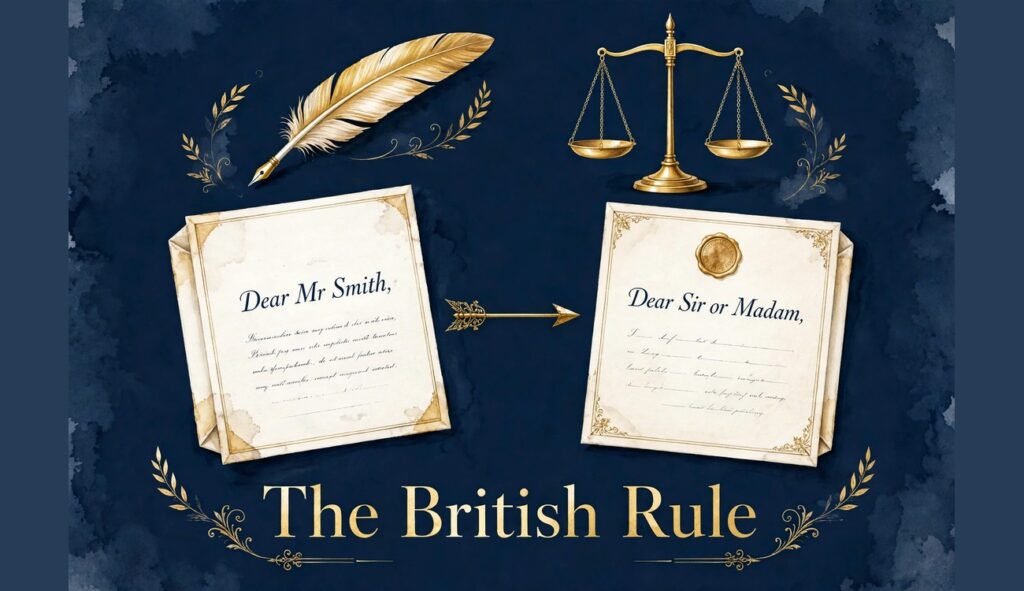
The British rule is simple to state and easy to apply, but it is worth understanding properly, because it explains every other piece of advice in this guide. The rule is: the closing must match the greeting. The words you put at the start of the letter decide the words you put at the end of it.
This is not a modern invention. The convention goes back to the nineteenth century, when business correspondence first became standardised, and it was set out in the great usage guides of the twentieth century. Fowler’s Dictionary of Modern English Usage advised writers to use “Yours sincerely” when replying to invitations and friendly, but not intimate, letters, and “Yours faithfully” when writing to unknown persons on business matters. The Oxford Handbook of Commercial Correspondence put it even more plainly: use “Yours sincerely” when you know the person’s name, and “Yours faithfully” when you begin with “Dear Sir/Madam”.
The rule works because it is really a rule about honesty. A formal letter is a kind of performance: you are being polite to a stranger, or to someone you know only in a professional capacity. The greeting tells the truth about the relationship — you know this person’s name, or you do not — and the closing tells the same truth back. That is why the mismatch is so jarring when it happens. A letter that opens “Dear Sir or Madam” and closes “Yours sincerely” is claiming a personal connection that the greeting has just denied. A letter that opens “Dear Mr Smith” and closes “Yours faithfully” is being oddly distant with a man whose name it has just used.
It is also worth knowing that the rule is about the greeting on the page, not about whether you actually know the person in real life. You might know perfectly well that the hiring manager is called Ms Patel, but if you address your letter “Dear Sir or Madam” because you are writing to the company generally, then the traditional closing is “Yours faithfully”. And the other way round: you might never have met Dr Ahmed, but if your letter begins “Dear Dr Ahmed”, the closing is “Yours sincerely”. What matters is the name in the greeting, not the relationship behind it.
That is what decides faithfully or yours sincerely every time. Do not ask yourself how formal you want to be, or how warm you feel towards the reader. Ask yourself one question instead: did I use their name in the greeting? If yes, “Yours sincerely”. If no, “Yours faithfully”.
How the Rule Works in Practice
- You found the name on the company website. Your letter begins “Dear Mr Thompson”. Close with “Yours sincerely”.
- You are writing to a department, not a person. Your letter begins “Dear Sir or Madam”. Close with “Yours faithfully”.
- You were given a name by a colleague. Your letter begins “Dear Ms Carter”. Close with “Yours sincerely”.
- You are replying to a letter signed only with a job title. Your reply begins “Dear Sir or Madam”. Close with “Yours faithfully”.
Yours Sincerely: When You Know the Name
“Yours sincerely” is the closing to reach for whenever your letter is addressed to a named person. It covers more situations than most people realise, because a named recipient does not have to be a friend, a colleague or someone you have met. It only has to be a person whose name appears in your greeting.
Use “Yours sincerely” for:
- Job applications addressed to a named hiring manager — “Dear Ms Patel” and then “Yours sincerely” is the classic combination, and it is the one that recruiters in the UK expect to see.
- Thank-you letters to a named person — thanking an interviewer, a client or a supplier by name.
- Replies to letters that were signed by a named person — if they wrote to you as “John Davies”, you write back to “Dear Mr Davies” and close with “Yours sincerely”.
- Formal invitations and acceptances — replying to an invitation from a named host.
- Business letters to a known contact — writing to your account manager, your solicitor or your bank manager by name.
The greeting can use a title and surname (“Dear Mr Smith”, “Dear Mrs Okafor”, “Dear Ms Nguyen”, “Dear Dr Ahmed”) or, in slightly less formal business writing, a full name (“Dear Sarah Jones”). Either way, the closing is the same. You do not need to know the person personally, and you do not need to have spoken to them before. The name in the greeting is the only thing that triggers the closing.
One point that catches people out: the title matters, and getting it right is part of the same courtesy. “Ms” is the right title when you do not know a woman’s marital status, or when she prefers it, and it takes no full stop in British usage. “Mrs” is for a married woman who uses that title, “Miss” for an unmarried woman who uses it, and “Dr” for someone with a doctorate or a medical qualification. If you are unsure, “Ms” is the safe choice, and it is far better to use it than to guess wrong.
A Full Example: Replying to a Named Person
Dear Mr Thompson,
Thank you for your letter of 3 November regarding the repair to my washing machine. I am pleased to confirm that the engineer visited yesterday and the machine is now working properly.
I am grateful for your prompt attention to this matter.
Yours sincerely,
Emma Wilson
Yours Faithfully: When You Do Not Know the Name
“Yours faithfully” is the closing for letters where the recipient is unknown. You use it when you are writing to a role, a department or an organisation rather than to a person — and that is a large share of all formal letters.
Use “Yours faithfully” for:
- General enquiries — writing to a company, a council or a university to ask for information.
- Formal complaints — complaining to a business or an organisation when you do not have a named contact.
- Job applications to an unnamed address — applying for an advertised role where no hiring manager is named, and the application goes to “the Recruitment Team” or simply to the company.
- Letters to editors and officials — writing to a newspaper, a government department or a public body.
- Requests for information or action — asking an organisation to send you something, correct something or explain something.
The key point is that “Yours faithfully” is not a lesser closing, and it is not a sign that you care less. It is the most formal closing in British English, and using it correctly shows that you understand the conventions. A complaint letter that opens “Dear Sir or Madam” and closes “Yours faithfully” is exactly right — it is formal, respectful and consistent from the first line to the last.
There is one situation that deserves a special mention: the job application where no name is given. This is the case that worries people most, because the letter matters so much. If the advertisement says “apply to the HR Department” or gives only an email address, your letter begins “Dear Sir or Madam” and ends “Yours faithfully”. It is always worth trying to find a name first — a quick look at the company website or a short phone call can turn an anonymous application into a personal one — but if you cannot find one, “Yours faithfully” is correct, and no recruiter will think less of you for it.
A Full Example: A Complaint to an Unknown Recipient
Dear Sir or Madam,
I am writing to complain about the service I received at your Oxford Street branch on Saturday 8 November. I waited for over an hour to be served, and when I raised the matter with a member of staff, I was told there was nothing they could do.
I would like a full explanation of what happened, and I would be grateful if you could confirm what steps you will take to prevent it from happening again.
Yours faithfully,
James Carter
American English: Sincerely and Sincerely Yours
Everything above describes British English. American English is different, and the difference matters, because the two systems are easy to mix up — especially in emails, where a British reader and an American reader may be reading the same message.
In the United States, “Yours faithfully” is rarely used at all. Most Americans would never write it, and many would find it old-fashioned or puzzling. The standard American closings are:
- Sincerely — the most common formal closing in the US, used for almost any formal or business letter.
- Sincerely yours — a slightly warmer version of the same closing, also very common.
- Yours truly — used in American business letters, though it sounds old-fashioned to many modern readers.
- Respectfully or Respectfully yours — used for very formal letters, especially to government officials or people in authority.
- Best regards / Kind regards — the standard semi-formal closings in American business emails.
The important difference is that American usage does not have the British name rule. An American writer uses “Sincerely” whether they know the recipient’s name or not. The closing does not change with the greeting. “Dear Mr Smith” and “Dear Sir or Madam” can both be followed, at the end of the letter, by “Sincerely,”. That is one reason American readers sometimes find the British system confusing: to them, the closing is a matter of tone, not a matter of matching the greeting.
There is also a small but telling difference in the wording itself. Americans say “Sincerely yours”; the British say “Yours sincerely”. The two phrases are mirror images of each other, and each one sounds slightly wrong to a reader from the other side of the Atlantic. If you are writing to an American company, use the American form. If you are writing to a British company, use the British form. The reader will not mark you down for using the other country’s convention, but using their own shows that you have paid attention.
One more American habit is worth knowing: Americans frequently use “truly” in place of “sincerely” in longer closings — “Yours truly”, “Very truly yours” — and the single word “Sincerely” is probably the most informal of the formal options. The three-word versions, like “Very sincerely yours”, are the most overtly formal. As a rule of thumb, the longer the closing, the more formal it sounds, in both British and American English.
British vs American Closings
This table brings the two systems together, so you can see at a glance which closing belongs where.
| Closing | British English | American English |
|---|---|---|
| Yours faithfully | Standard for an unnamed recipient (Dear Sir or Madam) | Rarely used |
| Yours sincerely | Standard for a named recipient (Dear Mr Smith) | Understood, but less common |
| Sincerely | Understood, but less traditional | The most common formal closing |
| Sincerely yours | Rare in British letters | Common and standard |
| Yours truly | Archaic in modern British English | Used, but old-fashioned |
| Respectfully / Respectfully yours | Rare in British business letters | Formal, often for officials |
| Kind regards / Best regards | Semi-formal, very common in emails | Semi-formal, very common in emails |
| Regards | Semi-formal, works with or without a name | Semi-formal, works with or without a name |
The practical lesson is simple. If you are writing in British English, follow the British rule: name in the greeting means “Yours sincerely”, no name means “Yours faithfully”. If you are writing in American English, “Sincerely” will serve you well in almost every formal situation, whatever the greeting says. And if you are writing to someone in another country, it is worth taking a moment to find out which convention they use — it is a small courtesy that makes a good first impression.
Capitalisation and Punctuation: The Small Details
Getting the closing right is only half the job. The small details — capital letters and commas — are where careful writers still slip up, and they are exactly the kind of thing an employer or an exam marker will notice.
Capital Letters: Only “Yours” Is Capitalised
In both closings, only the first word takes a capital letter. It is “Yours sincerely” and “Yours faithfully” — never “Yours Sincerely” and never “Yours Faithfully”. The second word is always lower case.
This is the rule in British English, and it is the rule in the major style guides. It surprises people, because the closing feels important enough to deserve two capital letters, but the convention is clear. A letter that ends “Yours Faithfully,” has made a small but visible mistake, and it is the kind of mistake that suggests the writer copied the phrase without ever having been taught it properly.
The same rule applies to the other closings in this guide. It is “Kind regards”, not “Kind Regards”. It is “Best wishes”, not “Best Wishes”. Only the first word is capitalised, every time.
The Comma: American Yes, British Maybe
Whether to put a comma after the closing depends on which style you are following.
- American style uses a comma: “Sincerely,” and then your name on the next line. This is the standard in the United States, and it is what American readers expect.
- Modern British style often uses no comma at all: “Yours sincerely” on one line and your name on the next, with no punctuation between them. This is increasingly common in British business writing, and it is the style most British organisations now use.
- Traditional British style used a comma, and you will still see it in older letters and in some exam guidance. It is not wrong — it is simply the older way of doing it.
What matters most is consistency. If you put a comma after the greeting — “Dear Mr Smith,” — then put one after the closing too. If you leave the comma off the greeting, leave it off the closing as well. A letter that mixes the two styles looks careless, even though each choice on its own would be fine.
The same applies to the greeting itself. In modern British business letters, the greeting often has no comma either: “Dear Mr Smith” and then the first paragraph. In American letters, the greeting usually takes a colon in very formal letters (“Dear Mr Smith:”) and a comma in ordinary business letters (“Dear Mr Smith,”). Again, the point is to pick one style and stick to it for the whole letter.
Where the Closing Goes
The closing sits on its own line, after the last paragraph of the letter, with a blank line between the last paragraph and the closing. Your name goes on the line below the closing. If you are signing a paper letter, leave three or four blank lines between the closing and your printed name, so there is room for your signature. In an email, the closing and your name can sit directly above your email signature block.
A final detail: never put a full stop after the closing. “Yours sincerely.” is wrong. The closing is not a sentence, so it takes no full stop — only a comma, if your style uses one, and nothing at all if it does not.
Common Mistakes to Avoid
The most common error in the whole faithfully or yours sincerely question is also the simplest: mixing up the two closings. But there are several other mistakes that appear again and again, and they are all easy to avoid once you know what they are.
Using “Yours Faithfully” with a Named Recipient
This is the classic mistake. The letter begins “Dear Mr Smith” and ends “Yours faithfully”. The writer has used the recipient’s name and then closed as though they had not. It is the single most common error in formal letter writing, and it is the one that exam markers test most often. If you remember only one thing from this guide, remember this: a name in the greeting means “Yours sincerely”, every time.
Using “Yours Sincerely” with “Dear Sir or Madam”
This is the same mistake in reverse. The letter begins “Dear Sir or Madam” and ends “Yours sincerely”. The writer is being warm and personal towards someone whose name they do not even know, and the inconsistency is obvious to any reader who knows the convention. The closing must match the greeting — if there is no name at the top, there is no “sincerely” at the bottom.
Writing “Faithfully” on Its Own
“Faithfully,” on its own is not a closing. Neither is “Sincerely” a British closing in the traditional sense — although Americans do use the single word “Sincerely” on its own, and in American English it is perfectly correct. In British English, the closing is always two words: “Yours faithfully” or “Yours sincerely”. Dropping the “Yours” is not a modern shortcut; it is simply wrong in the British system.
Writing “Your Sincerely” or “Your Faithfully”
“Your” and “Yours” are different words, and this is one of the most embarrassing mistakes in formal writing. “Your sincerely” is never correct. The closing is “Yours sincerely” — with an “s” — because it is short for “I am yours, sincerely”. It is a small difference in spelling and a large difference in meaning, so it is worth checking every time.
Capitalising the Second Word
“Yours Sincerely” and “Yours Faithfully”, with a capital “S” or “F”, are both wrong. Only the first word is capitalised. This mistake usually comes from copying the phrase from somewhere it was written as a heading, where every word is capitalised, and pasting it into a letter without adjusting it.
Copying the Closing from the Wrong Country
A British writer who ends a letter “Sincerely yours,” has used the American form, and an American writer who ends a letter “Yours faithfully,” has used the British form. Neither is a disaster — both will be understood — but each one tells the reader that the writer did not think about who they were writing to. Matching the convention to the reader’s country is a small courtesy, and in a job application it is a courtesy worth making. The same kind of one-letter carelessness causes trouble in other confusions too: the guide to Fourty or Forty shows how a single missing letter can be the whole difference between right and wrong, and the same attention to detail matters here.
Using a Formal Closing in an Informal Email
“Yours faithfully” at the end of a quick email to a colleague you see every day looks stiff and strange. Formal closings belong to formal letters. If you are writing to someone you know well, “Kind regards” or “Best regards” is almost always the better choice, and for a close colleague, even “Thanks” or “Best” will do. The closing should match the relationship, not just the greeting.
Modern Email Alternatives: Kind Regards, Best Regards, Warm Regards

Formal letters are not the only place where closings matter. Most of the writing we do today is email, and email has its own conventions — looser than the traditional letter, but still worth getting right.
In a modern business email, the most common closings are:
- Kind regards — the safest all-round choice. Warm enough to be friendly, formal enough for business. It works whether you know the reader’s name or not, which is why it has become the default in British workplaces.
- Best regards — very similar to “Kind regards”, and just as common. Some people feel it is a touch warmer; in practice, the two are interchangeable.
- Warm regards — warmer still, and best used when you already have a friendly relationship with the reader. It can feel too familiar for a first email to a stranger.
- Regards — short, neutral and professional. It works in almost any business email, and it is the closing to use when you want to keep things brief.
- Best — very common in American business emails, and increasingly used in British ones too. It is friendly and informal, but not too casual for work.
- Many thanks / Thanks — good when the email is a request or when someone has helped you. “Many thanks” is warmer than “Thanks”, and both are fine in a business context.
- Best wishes — friendly and a little more personal than “Kind regards”. Good for colleagues you know well, but too warm for a first email to a stranger.
The key point is that none of these replaces “Yours sincerely” or “Yours faithfully” in a truly formal letter. If you are writing a formal letter of complaint, a job application on paper, or a letter to a government department, the traditional closings are still the right choice. But for the everyday email — the message to a supplier, the reply to a client, the note to a colleague — “Kind regards” and “Best regards” are the modern standard, and nobody will think less of you for using them.
It is also worth knowing when to drop the closing altogether. In a long email chain, where you have already exchanged several messages with the same person, the sign-off often disappears after the first reply. That is normal, and it is not rude. The closing does its work in the first message; after that, your name in the signature block is enough. The same applies to very short internal messages: a two-line email to a colleague does not need “Kind regards” at the end of it.
What About “Yours” in Emails?
You can use “Yours sincerely” and “Yours faithfully” in emails, and in a formal email they are still correct. A job application sent by email to a named hiring manager can perfectly well end “Yours sincerely”. But most people now use “Kind regards” or “Best regards” for emails, even formal ones, because email itself feels less formal than a letter on paper. The traditional closings have not disappeared — they have simply moved to the most formal end of the scale, and “Kind regards” has taken over the middle ground.
Formal vs Semi-Formal Closings
Not every closing carries the same weight. This table puts the main closings on a scale, from the most formal to the most casual, so you can pick the right one for the letter or email in front of you.
| Closing | Formality | Best for |
|---|---|---|
| Yours faithfully | Very formal | Formal letters to an unnamed recipient |
| Yours sincerely | Formal | Formal letters to a named recipient |
| Sincerely / Sincerely yours | Formal (mainly American) | Formal letters and business emails in the US |
| Respectfully yours | Very formal (mainly American) | Letters to officials and people in authority |
| Kind regards | Semi-formal | Most business emails |
| Best regards | Semi-formal | Most business emails |
| Warm regards | Semi-formal, warm | Emails to people you already know |
| Regards | Semi-formal, neutral | Short business emails |
| Best wishes | Semi-formal, friendly | Colleagues and contacts you know well |
| Best / Thanks | Informal | Everyday internal emails |
The lesson of the table is that formality is a scale, not a switch. “Yours faithfully” and “Yours sincerely” sit at the formal end, “Kind regards” and “Best regards” sit in the middle, and “Best” and “Thanks” sit at the casual end. Your job is to pick the point on the scale that matches the reader and the situation — and then to be consistent about it.
Example Sign-Offs: Cover Letter, Complaint Letter, Enquiry Email
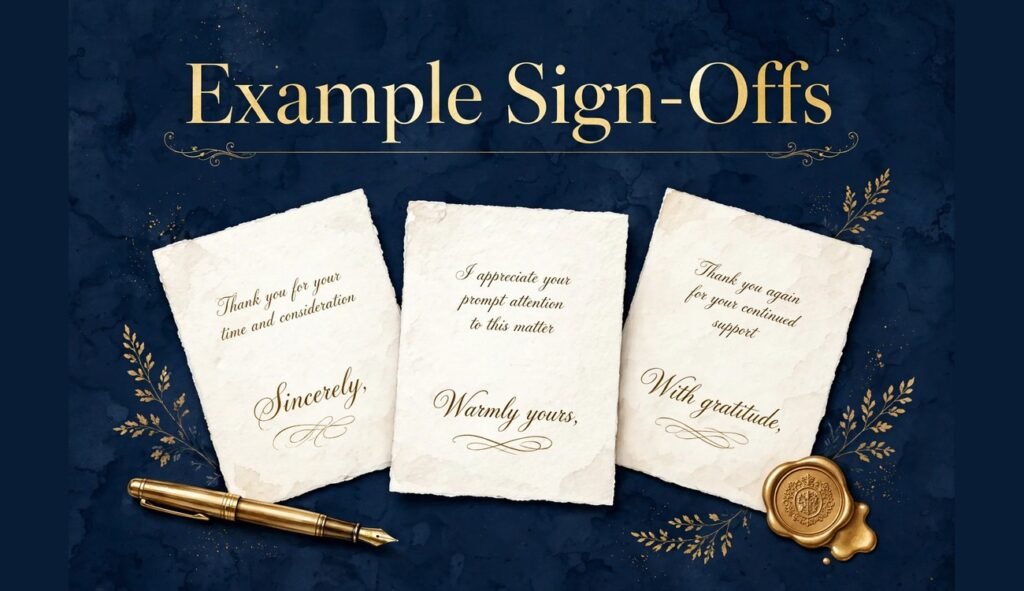
Rules are useful, but examples are what actually stick. Here are three complete sign-offs, for the three situations where people most often get stuck.
Example 1: A Cover Letter for a Job Application
This is a formal letter to a named hiring manager. The greeting uses her name, so the closing is “Yours sincerely”.
Dear Ms Patel,
I am writing to apply for the position of Marketing Assistant, as advertised on your website on 10 November. I have three years of experience in digital marketing, and I believe my skills would be a strong match for the role.
I have enclosed my CV and would welcome the opportunity to discuss my application with you at an interview.
Yours sincerely,
Sarah Jones
Why it works: the advertisement named the hiring manager, so the letter opens with her name and closes with “Yours sincerely”. The tone is formal throughout, the closing matches the greeting, and the letter ends on a confident, professional note. If the advertisement had not named anyone, the same letter would open “Dear Sir or Madam” and close “Yours faithfully” instead.
Example 2: A Complaint Letter to a Company
This is a formal letter to an unknown recipient. The greeting is general, so the closing is “Yours faithfully”.
Dear Sir or Madam,
I am writing to complain about the service I received at your Manchester branch on Saturday 8 November. I waited for over an hour to be served, and when I raised the matter with a member of staff, I was told that nothing could be done.
I would like a full explanation of what happened, and I would be grateful if you could confirm what steps you will take to prevent this from happening again.
Yours faithfully,
James Carter
Why it works: the writer does not know who will read the complaint, so the letter opens with a general greeting and closes with the most formal closing. The tone stays measured and factual all the way through — which is exactly what a good complaint letter should do. Notice that the letter never claims a personal relationship with the reader, and the closing does not pretend to one either.
Example 3: An Enquiry Email
This is a semi-formal email, and it shows how the modern alternatives work. The writer knows the recipient’s name, but the message is an email rather than a formal letter, so “Kind regards” is the natural choice.
Dear Mr Ahmed,
I hope you are well. I am writing to ask whether your company offers training courses for new starters. I would be grateful if you could send me details of the courses available, including the dates and the fees.
Thank you for your help.
Kind regards,
Emma Wilson
Why it works: the email is polite and professional without being stiff. “Kind regards” is warm enough for a first email to a named person, and it suits the medium — an email is less formal than a letter on paper, and the closing reflects that. If the same enquiry were sent as a formal letter instead, it would close with “Yours sincerely”, because the greeting names Mr Ahmed. And if the writer did not know his name at all, a formal letter would open “Dear Sir or Madam” and close “Yours faithfully”. The greeting decides, in every case.
A Note on Templates
Some employers, universities and public organisations give applicants a letter template to use. If you are given one, use it — even if it tells you to do something different from what you have learned here. A template is an instruction from the organisation itself, and following it matters more than following the general rule. The same goes for a specific request in a job advertisement: if it says “please end your letter with Kind regards”, then do exactly that. The rules in this guide are the default. A direct instruction from the reader always wins.
Frequently Asked Questions
These are the questions readers ask most often about faithfully or yours sincerely. If your question is not answered here, the rule itself will answer it: look at the greeting, and the closing follows.
Is it “Yours faithfully” or “Yours sincerely” when you know the person’s name?
It is “Yours sincerely”. When you know the recipient’s name and you have used it in the greeting — “Dear Mr Smith”, “Dear Ms Patel”, “Dear Dr Ahmed” — the traditional British closing is “Yours sincerely”. “Yours faithfully” is reserved for letters where the recipient’s name is unknown and the greeting is general, such as “Dear Sir or Madam”.
Can I use “Yours faithfully” with “Dear Mr Smith”?
No. This is the most common mistake in formal letter writing. “Dear Mr Smith” names the recipient, so the closing must be “Yours sincerely”. Using “Yours faithfully” after a named greeting breaks the rule that the closing must match the greeting, and any reader who knows the convention will notice. If you have the name, use it — in the greeting and in the closing that goes with it.
Is “Faithfully” on its own a correct closing?
No. “Faithfully” on its own is not a standard closing in any variety of English. The closing is always two words: “Yours faithfully”. The same is true of the other closing — it is always “Yours sincerely”, never just “Sincerely”, in traditional British usage. (In American English, the single word “Sincerely” is standard, but that is a different convention.) Dropping the “Yours” is not a modern shortcut; it is simply wrong in the British system.
Do Americans use “Yours faithfully”?
Almost never. “Yours faithfully” is a British closing, and it is rarely used in the United States. The standard American formal closings are “Sincerely” and “Sincerely yours”, and Americans use them whether or not they know the recipient’s name — American usage has no equivalent of the British name rule. If you are writing to an American company, “Sincerely” is the safe choice. If you are writing to a British company, follow the British rule instead.
Should there be a comma after “Yours sincerely”?
It depends on the style you are following. American style uses a comma: “Sincerely,” and then your name. Modern British style often uses no comma at all: “Yours sincerely” on one line and your name on the next. Traditional British style used a comma, and you will still see it in older letters. None of these is wrong on its own — what matters is consistency. If you put a comma after the greeting, put one after the closing too; if you leave it off the greeting, leave it off the closing as well.
What is the difference between faithfully or yours sincerely?
The difference is the greeting they match. “Yours faithfully” goes with a general greeting where the recipient’s name is unknown — “Dear Sir or Madam”. “Yours sincerely” goes with a greeting that names the recipient — “Dear Mr Smith”. “Yours faithfully” is also the more formal of the two, and it is the most formal closing in British English. In meaning, “faithfully” suggests loyalty and reliability, while “sincerely” suggests honesty and genuineness — but in practice both closings are conventional formulas, and the choice between them is decided by the greeting, not by what you feel towards the reader.
What should I use instead in a modern email?
For most business emails, “Kind regards” or “Best regards” is the modern standard. They are warm enough to be friendly and formal enough for work, and they work whether you know the reader’s name or not. “Warm regards” is a little warmer and suits people you already know. For a formal email — a job application, a complaint, a letter to a government department — “Yours sincerely” and “Yours faithfully” are still correct, and the same rule applies: a named greeting takes “Yours sincerely”, and a general greeting takes “Yours faithfully”.
Conclusion
The faithfully or yours sincerely question is one of the easiest in English to get right — and one of the easiest to get wrong. The rule itself could not be simpler: look at the greeting. If it names the recipient, close with “Yours sincerely”. If it does not, close with “Yours faithfully”. Everything else in this guide — the American difference, the capitalisation, the comma, the modern email alternatives — is detail around that one central rule.
It is worth learning properly, because formal writing is judged on its details. A letter that gets the closing right tells the reader, before they have even read the first paragraph, that the writer knows what they are doing. And the same attention to detail matters in every word you choose: the guide to Verbiage vs Verbage shows how a single letter can be the whole difference between right and wrong, and a closing is no different. Get the small things right, and the big things follow.
So the next time you sit down to write a formal letter, do not guess. Check the greeting, pick the closing that matches it, and write it with confidence. And if you ever want to double-check the meaning of the words themselves, the dictionary definition of sincerely confirms what the word means and how it is used. “Yours sincerely” for a named reader, “Yours faithfully” for an unknown one — now you know which is which, and you will never have to guess again.
Author: Emily Carter
[…] you choose — and how you spell it — deserves the same care as the opening, as the guide to Faithfully or Yours Sincerely […]