
Verbiage vs verbage — which spelling is correct? The answer is simple: verbiage is the correct spelling, and verbage is a misspelling. If you have ever typed “verbage” into a document and watched the red squiggly line appear underneath it, you already suspected something was wrong. This guide explains exactly what is wrong, why so many people make the same mistake, and how to never get it wrong again.
Verbiage is a real English noun with a long history. It means an excess of words — wordiness — or, more neutrally, the wording of something. Verbage, on the other hand, does not appear in any major standard dictionary. Not in Merriam-Webster, not in Cambridge, not in Oxford Learner’s. It is what happens when a tricky pronunciation meets a quiet, unstressed letter in the middle of a word.
In this article, you will learn the exact verbiage meaning and definition, how to pronounce verbiage correctly, why the misspelling is so common, easy tricks to remember the right spelling, plenty of example sentences, and the best synonyms to use instead. By the end, the difference will be locked in for good.
Quick Answer: Verbiage vs Verbage
Use verbiage. Always.
- Verbiage — correct. A noun meaning either an excess of words, or the wording and diction of a piece of writing or speech.
- Verbage — incorrect. A common misspelling of verbiage. It is not a standard English word, so do not use it in formal writing, schoolwork, or professional documents.
- Pronunciation: VER-bee-ij (three syllables, with the stress on the first).
- Memory trick: “I should use verb-I-age.” The correct spelling contains the letter I — verbage does not.
If you only remember one thing from this article, remember that: verbiage has an “I” in it, and verbage is the version without one.
Verbiage vs Verbage at a Glance
| Feature | Verbiage | Verbage |
|---|---|---|
| Spelling | Correct | Incorrect |
| Status | Standard English word | Nonstandard spelling / misspelling |
| Part of speech | Noun | Not a word — no part of speech |
| Meaning | Excess of words; wording or diction | No meaning of its own |
| In Merriam-Webster? | Yes | No entry |
| In Cambridge? | Yes | No entry |
| In Oxford Learner’s? | Yes | No entry |
| Safe in formal writing? | Yes | No |
| Pronunciation | VER-bee-ij | Usually the same mispronunciation that caused the mistake |
The table tells the whole story at a glance: one of these spellings is a word, and the other is not. Everything else in this article explains why, and how to make sure you always pick the right one.
What Does Verbiage Mean?
The verbiage definition has two senses, and knowing both of them is the key to using the word well. Most of the time, people use verbiage in the first sense — too many words. But the second sense is neutral, and it shows up in business, legal, and academic writing all the time.
Sense 1: Too Many Words
In its most common sense, verbiage means an excess of words — language that goes on and on without adding much meaning. It is the polite, formal way of saying that someone is being wordy.
- The report was clear, but it was buried under pages of unnecessary verbiage.
- “Cut the verbiage,” the editor said. “Tell me what happened in two sentences.”
- His speech was mostly verbiage, with very little actual information in it.
When verbiage is used this way, it carries a slightly negative tone. It is not quite an insult, but it is a criticism: the words are there, but the substance is not. If someone says your writing has too much verbiage, they are telling you to tighten it up.
Sense 2: Wording or Diction
In its second, neutral sense, verbiage simply means the wording of something — the particular words a person chose to express an idea. There is nothing negative about this sense at all.
- The contract’s verbiage was carefully reviewed by three lawyers before signing.
- She asked the team to keep the verbiage of the announcement simple and warm.
- The verbiage on the warning label had to be exact, because lives depended on it.
Here, verbiage is just a formal word for “wording.” It is the kind of word you meet in contracts, policy documents, and official notices, where the exact words matter.
Verbiage in Legal and Business Writing
Verbiage shows up in legal and business writing more than anywhere else, and almost always in the neutral sense. Lawyers talk about the verbiage of a clause. Managers talk about the verbiage of a policy. In these settings, the word is not a criticism — it is a precise way of talking about language itself.
That is also why getting the spelling right matters so much in those settings. A lawyer who writes “verbage” in a contract, or a manager who writes it in a company-wide email, has made a small mistake that a lot of people will notice. The word is formal, so the people reading it tend to be the people who care about spelling.
What Is Verbage?
Now for the other side of the pair. If verbiage is the real word, what exactly is verbage?
Is Verbage a Real Word?
No. Verbage is not a word in standard modern English. No current standard dictionary gives it an entry — not Merriam-Webster, not Cambridge, not Oxford Learner’s, not Collins. When you look it up, you will either find nothing at all, or you will be redirected to verbiage with a note that verbage is a misspelling.
That does not mean nobody uses it. People write “verbage” all the time — in emails, in social media posts, in student essays, even in published articles that slipped past an editor. A word can be common and still be wrong. “Verbage” is one of the best examples of that: it is a frequent mistake, not an accepted alternative.
Your spellchecker agrees. Type “verbage” into Microsoft Word, Google Docs, or your phone keyboard, and it will underline it in red. That is the software telling you what the dictionaries say: this spelling does not exist in standard English.
Where Did Verbage Come From?
Verbage was not invented yesterday. It is recorded as a variant spelling as early as 1787, which means people have been dropping that middle “I” for well over two centuries. The mistake is old because the cause of the mistake is old: the way the word sounds.
Some writers have also suggested that verbage survives because it feels like a blend of “verbiage” and “garbage” — a handy word for wording that is not just wordy but worthless. That is a neat theory, and it may explain why the misspelling feels so natural to some people, but it does not make verbage a real word. A clever blend is still a blend, and dictionaries do not list it as standard.
The honest history is simpler: people hear “VER-bij,” they write what they hear, and “verbage” is what comes out. The next section looks at the dictionary evidence in detail, and the one after that explains the pronunciation trap step by step.
The Dictionary Record
When two spellings compete, the dictionaries settle the argument. Here is what the major references say about verbiage vs verbage:
| Dictionary | Verbiage | Verbage |
|---|---|---|
| Merriam-Webster | Entered, with two senses: (1) a profusion of words, usually of little or obscure content; (2) manner of expressing oneself in words, diction | No entry |
| Cambridge | Entered: “language that is very complicated and contains a lot of unnecessary words” | No entry |
| Oxford Learner’s | Entered: “the use of too many words, or of more difficult words than are needed” | No entry |
| Etymonline | Entered: from French verbiage, dated to 1721 | Recorded as a variant as early as 1787, but not a standard entry |
The pattern could not be clearer. Every major dictionary enters verbiage and none of them enters verbage as a standard word. Etymonline’s note is the interesting one: it acknowledges that “verbage” has appeared in print since 1787, which proves the misspelling is old — but it still does not treat it as a standard spelling. Age alone does not make a spelling correct. People have been writing “seperate” instead of “separate” for a very long time too, and it is still wrong.
This is also why you should not trust every website that tells you verbage is fine. Some low-quality pages, content mills, and AI-generated sites repeat the misspelling so often that it starts to look normal. But the dictionaries — the references that professional writers, editors, teachers, and exam markers actually use — are unanimous. Verbiage is the word. Verbage is the mistake.
Why Do People Write “Verbage”?
If verbage is so clearly wrong, why do so many smart, careful people write it? The answer is that the mistake is not caused by carelessness. It is caused by the word itself. Verbiage is built to be misspelled, and here is how.
The Pronunciation Trap
The main reason people write “verbage” is that many people say the word as VER-bij — two syllables — instead of VER-bee-ij, which has three. When you say VER-bij, the middle “ee” sound disappears, and with it goes the letter “I” that makes that sound. Write down what you hear, and you get “verbage.”
This is the same trap that catches people with dozens of other English words. Spelling follows sound, and when a sound is swallowed in everyday speech, the letter that represents it gets swallowed in writing too. English is full of these traps — the same kind of one-letter confusion shows up in Fourty or Forty, where a single missing letter is the whole difference between right and wrong.
The Missing “I”
Look at the two spellings side by side: verbiage and verbage. The only difference is the letter “I” sitting between the “b” and the “a.” That “I” is unstressed — it is not the loudest part of the word — so the ear skips over it and the hand follows.
It helps to know that this “I” is doing real work. Verbiage comes from the French verbiage, which came from verbier, meaning to chatter or to trill like a bird. The “I” is part of the word’s history. It has been there since the word entered English in the early 1700s, and it belongs there.
It Looks Like Other Words
Verbage also feels right because English is full of words that end in “-age” and look just like it: garbage, cabbage, baggage, damage, language. Once your brain files verbiage in that pattern, “verbage” looks like it belongs. It is a perfectly reasonable guess — it just happens to be wrong.
This is the same reason spellcheckers are not a complete defence. Many people see the red underline under “verbage,” assume the software is being fussy, and type on regardless. Or they write on a phone, where autocorrect sometimes “fixes” the word into the wrong form, or does not flag it at all. Technology helps, but it cannot replace knowing the spelling.
Spellcheckers Do Not Always Save You
It is worth saying plainly: a spellchecker is a safety net, not a teacher. It will catch “verbage” most of the time, but it will not catch the moment you choose the wrong word entirely — writing “verbiage” when you meant “verbosity,” for example — and it will not help you at all in a handwritten exam or a job interview where you have to say the word out loud.
The only reliable fix is the one this article gives you: learn the pronunciation, learn the spelling, and learn a trick that makes both of them stick. The next two sections do exactly that.
How to Pronounce Verbiage
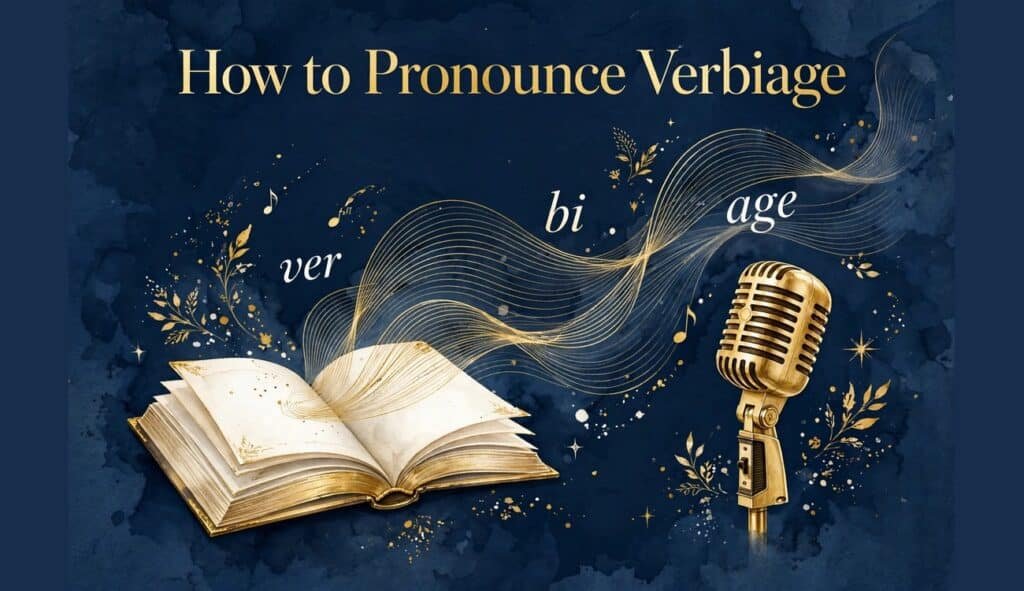
Getting the pronunciation right is the fastest way to get the spelling right. If you can hear all three syllables, you will write all eight letters.
Breaking It Into Syllables
Verbiage has three syllables: VER-bee-ij.
- VER — rhymes with “her” or “fur.” This is the stressed syllable, the one you say loudest.
- bee — exactly like the insect. This is the sound the misspelling drops.
- ij — a soft ending, like the end of “marriage” or “carriage.”
Say it slowly: VER — bee — ij. Then say it at normal speed: VER-bee-ij. That middle “bee” is the whole secret of the word. Hear it, and you will spell it.
British vs American Pronunciation
British and American speakers pronounce verbiage almost identically. In the International Phonetic Alphabet, the British pronunciation is /ˈvɜːbiɪdʒ/ and the American pronunciation is /ˈvɝːbiɪdʒ/. The only real difference is the vowel in the first syllable, which is a matter of accent, not of correctness.
What does not change between the two is the middle syllable. In both British and American English, the “bee” is there. So whichever side of the Atlantic you are on, the spelling rule is the same: if you can hear the “bee,” you can spell the word.
How NOT to Pronounce It
The mispronunciation to avoid is VER-bij — two syllables, with the middle sound squashed out of existence. It is extremely common, and it is the direct cause of the “verbage” misspelling. It is also the reason the mistake is so hard to notice: if everyone around you says VER-bij, writing “verbage” feels like writing what you hear.
Other mistakes are rarer but worth avoiding: do not stress the second syllable (ver-BEE-ij), and do not harden the ending into a “g” sound (VER-bee-ij, not VER-bee-ig). The final sound is the soft “zh” sound you hear in “vision” or “measure.”
A useful habit: every time you use the word, say it deliberately in your head first — VER-bee-ij — and let the spelling follow the sound. Within a few weeks, the correct version becomes automatic.
Easy Tricks to Remember the Spelling
You do not need to memorise a dictionary entry. You need one good trick. Here are four, and you only need the one that sticks for you.
The “I” Trick
The best trick is the simplest: “I should use verb-I-age.”
The correct spelling contains the letter “I,” and the misspelling does not. Say the sentence to yourself once — “I should use verb-I-age” — and you have a built-in reminder every time you write the word. The “I” is the difference between right and wrong, and now it is also the way you remember it.
The “Bee” Trick
If you like sound-based tricks, use the bee. Verbiage contains a “bee” in the middle — VER-bee-ij. Picture a bee sitting in the middle of the word, and you will never drop it again. It sounds childish, and that is exactly why it works: the sillier the image, the harder it is to forget.
Count the Letters
Verbiage has eight letters. Verbage has seven. If you are the kind of person who remembers numbers, remember this: the correct spelling is the longer one. Eight letters, three syllables, one word — verbiage.
Link It to “Verb”
Verbiage starts with verb, and it is a word about words. Verbs are the words that make sentences move, and verbiage is what you get when there are too many words in the way. That little connection — verb, words, verbiage — gives you the first four letters for free, and once you have “verb,” the rest of the word follows naturally: verb + I + age.
Pick one trick, use it three or four times this week, and the spelling will take care of itself. That is how spelling is actually learned — not by staring at a word, but by attaching it to something you already remember.
Verbiage in Sentences
Knowing the definition of verbiage is one thing. Using it naturally in a sentence is another. The examples below show the word at work in the places you are most likely to meet it — and to need it.
Formal Writing
Verbiage belongs in formal writing. It is a formal word, and it sounds at home in essays, reports, and letters where precision matters.
- The essay was well argued, but the verbiage in the introduction made it twice as long as it needed to be.
- Good writing is not about using impressive words; it is about cutting the verbiage and keeping the meaning.
- The committee asked the author to revise the proposal and remove the unnecessary verbiage from the first section.
Business and the Workplace
In the workplace, verbiage usually describes documents, emails, and presentations that take too long to say too little.
- The new policy was only two pages long, but the verbiage was so dense that nobody understood what had actually changed.
- “Please shorten this email,” her manager wrote. “The verbiage is hiding the actual request.”
- Investors do not have time for verbiage. They want numbers, dates, and decisions.
- The marketing team replaced the verbiage on the homepage with three short sentences, and sign-ups went up.
Legal Writing
In legal writing, verbiage is usually neutral — it means the wording of a document, and the wording is the whole point.
- The verbiage of the contract left no room for misunderstanding, which was exactly what both sides wanted.
- Two lawyers spent an afternoon debating the verbiage of a single clause.
- The judge asked the lawyers to agree on the verbiage of the settlement before the end of the day.
- Standard verbiage in these agreements covers liability, payment terms, and termination.
Academic Writing
Students and researchers meet verbiage in both senses: as a criticism of wordy writing, and as a neutral term for how something is phrased.
- The professor circled three paragraphs and wrote “verbiage” in the margin. The student rewrote them in half the space.
- Academic writing is often criticised for its verbiage, but the best journals prize clarity above all.
- The study compared the verbiage of two textbooks and found that the clearer one produced better test results.
- When you quote a source, keep its verbiage exact. Do not paraphrase a quotation.
Everyday Conversation
Verbiage is a formal word, so it sounds slightly dressed-up in everyday speech — but that is also what makes it useful when you want to sound precise.
- “I read the whole email twice and I still don’t know what he wants. It’s all verbiage.”
- She listened to the announcement and said, “That was five minutes of verbiage for one piece of news.”
- The instructions were full of verbiage, so he ignored them and figured it out himself.
Synonyms and Better Alternatives
Verbiage is a useful word, but it is not always the best word. Sometimes it sounds too formal, sometimes too negative, and sometimes it simply does not fit the sentence. Here are the best alternatives, and when to reach for each one.
Wordiness
Wordiness is the plainest synonym for verbiage in its first sense. It means using too many words, and it is the word most people would use in everyday conversation.
- The wordiness of the report made it hard to finish.
- Her first draft was full of wordiness, so she cut a third of it.
Use “wordiness” when you are talking to a general reader and you want to be understood instantly. Use “verbiage” when you want a more formal tone.
Verbosity
Verbosity is the noun for the quality of using too many words. It is close to verbiage, but there is a difference: verbosity describes a person’s habit or style, while verbiage describes the words themselves.
- His verbosity was legendary — he could talk for an hour and say nothing.
- The verbosity of the speech bored the audience.
Verbosity sounds more formal and more critical than verbiage. Save it for writing about style, and use verbiage when you are talking about a specific piece of text.
Prolixity
Prolixity is the most formal of the three, and the least common. It means the same thing — using too many words, being tediously long — but it belongs in literary or academic writing, not in an office email.
- The novel was criticised for its prolixity; the story could have been told in half the pages.
- His prolixity made even short meetings feel endless.
Most readers will know “wordiness” and “verbosity.” Fewer will know “prolixity.” Use it only when your audience is comfortable with formal vocabulary, or you risk replacing one problem — too many words — with another: a word nobody understands.
Wording and Diction
When verbiage is used in its neutral sense — the wording of something — the best alternatives are simply “wording” and “diction.”
- The wording of the contract was reviewed by three lawyers.
- Her diction was precise and formal, exactly as the occasion required.
“Wording” is the everyday choice. “Diction” is slightly more formal, and it usually describes a person’s way of speaking or writing rather than a single document. If the sentence is about a contract, a label, or an announcement, “wording” is almost always the clearer choice.
| Word | Meaning | Tone | Best used when |
|---|---|---|---|
| Verbiage | Excess of words; or wording | Formal, sometimes critical | Formal writing, legal and business documents |
| Wordiness | Using too many words | Plain, everyday | Talking to a general reader |
| Verbosity | The habit of using too many words | Formal, critical | Describing a person’s style |
| Prolixity | Tediously long-winded language | Very formal, literary | Academic or literary writing |
| Wording | The exact words used | Neutral, everyday | Contracts, labels, announcements |
| Diction | A person’s choice of words | Formal, neutral | Describing how someone speaks or writes |
The table makes the choice simple: if you want to criticise wordy writing in plain English, say “wordiness.” If you want to sound formal, say “verbiage” or “verbosity.” And if you mean the wording of a document, just say “wording.” The right synonym is the one your reader understands without stopping.
Verbiage vs Verbose, Verbosity, and Prolixity
Verbiage has several close relatives, and they are easy to mix up. Here is how they differ.
Verbiage vs Verbose
Verbiage is a noun. Verbose is an adjective. That is the whole difference, and it matters.
- Verbiage is the thing: “The verbiage in this report is excessive.”
- Verbose is the description: “This report is verbose.”
You would never say “the verbose in this report” — that is not a sentence. And you would never say “this report is verbiage” when you mean it is wordy. Noun and adjective, thing and description: keep them straight and both words will serve you well.
Verbiage vs Verbosity
Verbiage and verbosity are both nouns, and both are about too many words, but they point at different things. Verbiage is the excess words themselves — the text on the page. Verbosity is the quality or habit behind them — the tendency to use too many words.
- “Cut the verbiage” means cut the extra words from this document.
- “His verbosity is a problem” means he has a habit of using too many words, in general.
Think of it this way: verbosity is the cause, and verbiage is the result.
Verbiage vs Prolixity
Verbiage and prolixity overlap almost completely, and the difference is mostly one of register. Verbiage is formal but familiar — most educated readers know it. Prolixity is formal and rare — many readers will have to look it up.
In practice, that makes verbiage the better choice in almost every situation. Prolixity adds nothing except difficulty, which is ironic for a word that criticises unnecessary words. Use prolixity only when you are writing for an audience that enjoys formal vocabulary, and use verbiage everywhere else.
Common Mistakes to Avoid
The verbiage vs verbage question is the biggest mistake, but it is not the only one. Here are the other errors that show up again and again.
Using “Verbage” in Formal Writing
This is the mistake that costs the most. In a casual text message, “verbage” will be understood and probably forgiven. In a job application, a university essay, a business proposal, or a legal document, it will be noticed — and it will count against you.
The reason is simple: formal writing is judged on its details. A reader who sees “verbage” in a formal document does not just see a misspelling. They see a writer who did not check, or did not know. That is a harsh judgement for one missing letter, but it is how formal writing works. Get the spelling right, and the judgement never happens.
If you are not sure, check. Type the word into a dictionary, not just a spellchecker. Dictionaries tell you whether a word exists; spellcheckers only tell you whether it looks familiar.
Confusing Verbiage with Verbose
This is a grammar mistake rather than a spelling mistake, but it is just as common. Verbiage is a noun, verbose is an adjective, and they cannot be swapped.
- Correct: “The verbiage was excessive.” / “The speech was verbose.”
- Wrong: “The verbose was excessive.” / “The speech was verbiage.”
If you remember that verbiage is a thing and verbose describes a thing, you will never mix them up. English has the same one-letter traps in many other word pairs — the same kind of confusion appears in Fourty or Forty, where one small difference changes everything.
Overusing the Word Itself
There is a special irony in overusing the word “verbiage”: a paragraph that complains about verbiage, using the word five times, has become an example of the very thing it criticises. Use the word once, make your point, and move on. If you need it again, use one of the synonyms from the table above — “wordiness,” “wording,” or “verbosity” — and your writing will stay fresh.
Mispronouncing It in Meetings
Spelling mistakes live on the page, but pronunciation mistakes live in the room. Saying VER-bij in a meeting will not ruin your career, but it will quietly signal that you have only ever read the word and never heard it said properly. Say it correctly — VER-bee-ij — and nobody will notice, which is exactly the point. Correct pronunciation is invisible. Incorrect pronunciation is not.
Is Verbage Ever Acceptable?
After all of this, it is fair to ask: is there any situation where “verbage” is acceptable? The honest answer is no — not in standard English.
In Informal Writing?
In a text message to a friend, nobody will correct your spelling, and “verbage” will be perfectly understood. But being understood is not the same as being correct. The same is true of “seperate” or “definately”: people understand them, and they are still wrong. Informal writing forgives mistakes; it does not turn them into correct spellings.
There is also a practical problem. The words you use in informal writing are the words you will reach for in formal writing. If you train yourself to write “verbage” in texts and emails, that is the spelling your fingers will produce when it matters — in the job application, the essay, the report. Habits do not respect context. Build the right habit everywhere.
What About Slang Dictionaries?
A few online slang dictionaries and crowd-sourced word lists mention “verbage,” usually with a note that it is a misspelling or a nonstandard variant. That is not an endorsement. A slang dictionary records what people say, including their mistakes; a standard dictionary records what is correct. The two have different jobs, and only one of them decides what counts as correct English.
The same principle applies across the whole site. At GrammarSay, we cover these confusions one by one — spelling, meaning, pronunciation, and use — so that you can write with confidence instead of guessing. Verbiage vs verbage is one of the clearest cases there is: one spelling is right, one is wrong, and now you know which is which.
Frequently Asked Questions
Is “verbage” a word?
No. “Verbage” is not a word in standard modern English. No major dictionary — Merriam-Webster, Cambridge, Oxford Learner’s, or Collins — gives it an entry. It is a common misspelling of “verbiage,” caused by the way the word is pronounced. It has appeared in print since 1787, but age does not make a spelling correct, and it remains a mistake in formal writing.
What is the correct spelling — verbiage or verbage?
The correct spelling is verbiage. It has eight letters: V-E-R-B-I-A-G-E. The misspelling “verbage” drops the letter “I” from the middle of the word. A good way to remember it is the sentence “I should use verb-I-age” — the correct spelling contains an “I,” and the wrong one does not.
What does verbiage mean in simple words?
In simple words, verbiage means either too many words, or the particular words someone chose. When a report is full of verbiage, it means it uses more words than it needs. When a lawyer talks about the verbiage of a contract, they just mean the wording of the contract. The first sense is slightly negative; the second is neutral.
How do you pronounce verbiage?
Verbiage is pronounced VER-bee-ij, with three syllables and the stress on the first. The middle syllable sounds exactly like the insect “bee.” The most common mispronunciation is VER-bij, with only two syllables — and that missing “bee” sound is exactly what leads people to spell it “verbage.”
What is the difference between verbiage and verbosity?
Verbiage is the excess words themselves — the text on the page. Verbosity is the habit or quality of using too many words. So you would say “cut the verbiage” about a specific document, and “his verbosity is a problem” about a person who always talks too much. Verbosity is the cause; verbiage is the result.
Can I use verbiage in formal writing?
Yes. Verbiage is a formal word, and it is perfectly at home in essays, reports, business documents, and legal writing. Just make sure you spell it correctly — “verbiage,” with the “I” — and use it in the right sense. In formal writing, use it either to mean an excess of words or to mean the wording of a document. Both senses are correct.
What is a synonym for verbiage?
The best synonyms depend on which sense you mean. For “too many words,” use wordiness, verbosity, or prolixity. For “wording,” use wording or diction. In everyday conversation, “wordiness” is the clearest choice. In formal writing, “verbiage” itself is usually the best word — that is why it exists.
Conclusion
Verbiage vs verbage is one of the simplest spelling questions in English, and one of the easiest to get wrong. The correct spelling is verbiage — eight letters, three syllables, and one small “I” in the middle that makes all the difference. Verbage is a misspelling: old, common, understandable, and still wrong.
Remember the two things that will keep you right. First, the pronunciation: VER-bee-ij. Hear the “bee” in the middle, and you will write it. Second, the trick: “I should use verb-I-age.” The letter “I” is the difference between the word and the mistake, and now it is also the way you remember it.
If you want to check the dictionary entry for yourself, Merriam-Webster’s definition of verbiage gives both senses — an excess of words, and wording or diction — and confirms everything in this article. And the next time you catch yourself about to type “verbage,” stop, say VER-bee-ij in your head, and let the correct spelling follow.
Author: Emily Carter
[…] that makes people write “trainor” also produces mistakes like the one explained in Verbiage vs Verbage, where one small difference changes […]
[…] they are doing. And the same attention to detail matters in every word you choose: the guide to Verbiage vs Verbage shows how a single letter can be the whole difference between right and wrong, and a closing is no […]
[…] is a useful parallel here with another pair of lookalike words. In Verbiage vs Verbage, a single letter is the whole difference between a real word and a mistake, and the wrong version […]
[…] questions too — the family around a word usually tells you how to spell it, as the word pairs in Verbiage vs Verbage show in a different […]