

If you have ever written down a number as a word and stopped halfway, unsure whether to keep the letter E, you are not alone. The question of nineth or ninth is one of those small spelling puzzles that catches out students, job seekers, and confident writers alike. It looks like it should be simple. After all, the number is spelled N-I-N-E, so adding the usual ordinal ending should give you N-I-N-E-T-H — or should it?
Here is the short answer, right up front: ninth is correct, and nineth is wrong. There is no version of standard English — American, British, Canadian, or Australian — where “nineth” is the accepted spelling of the ordinal number. If you mean the thing that comes after the eighth and before the tenth, the word you want is ninth, spelled N-I-N-T-H, with no E after the N. In this guide, we will settle the question properly: what ninth means, why so many people write “nineth”, the rule that explains the missing E, how ninth compares with nineteenth and ninetieth, and the memory tricks that make the correct spelling stick.
Nineth or Ninth: The Quick Answer
Quick Answer: The correct spelling is ninth — N-I-N-T-H. Nineth is a misspelling and should never be used in standard English. The reason is a small but firm spelling rule: when the number nine becomes an ordinal number, the final E is dropped before the “-th” ending is added. Nine minus E plus TH gives you ninth. The debate over nineth or ninth is really no debate at all — every dictionary, every style guide, and every exam board agrees on the same answer.
The One-Second Test
If you are in a hurry, here is the fastest way to check yourself. Say the word “nine” and then say the word “ninth” out loud. Now count the letters. Nine has four letters. Ninth has five. If the word you have written has six letters, you have written “nineth”, and you have one letter too many. The correct word is five letters long: N-I-N-T-H.
What Does Ninth Mean?
Ninth is the ordinal form of the number nine. Ordinal numbers tell us the position or order of something in a series, rather than how many there are. First, second, third, fourth, fifth, sixth, seventh, eighth, ninth, tenth — each of these words answers the question “which one in the order?” rather than “how many?”. When something is ninth, it is the item that comes after the eighth and before the tenth.
The word works as both an adjective and a noun. As an adjective, it describes a position: “the ninth chapter”, “her ninth birthday”, “the ninth floor of the building”. As a noun, it can stand for the thing itself or for one of nine equal parts: “Today is the ninth of May”, “She owned a ninth of the company”, “The batter hit a home run in the bottom of the ninth”. In music, a ninth is also an interval — the distance of an octave plus a second.
Ninth as a Position
The most common use of ninth is to mark a position in a sequence. A runner who finishes ninth came in after eight other runners. A student in the ninth grade is in the year of school that follows the eighth grade. A book’s ninth edition is the version that follows the eighth edition. In every case, the word is doing the same job: it tells you where something sits in a line.
Ninth as a Date
In dates, ninth marks the ninth day of the month. “The meeting is on the ninth” means the ninth day of the current month. In formal writing, the date is often written out as “the ninth of May” or “May 9th”. In American English, “May 9” is common in print, but in speech, people almost always say “May ninth” or “the ninth of May”. The word is doing the same work in all of these forms: it names a day by its position in the month.
Ninth Pronunciation
Ninth is pronounced NYNTH — /naɪnθ/ — with the stress on the single syllable. It rhymes with “ninth” and nothing else in common use, which is part of why the spelling trips people up: there is no other everyday word that sounds quite like it. The final sound is the soft “th” sound, the same sound at the end of “tenth” and “month”, made by placing the tongue gently between the teeth. There is no separate vowel sound between the N and the TH, which is a useful clue: the word has no E because there is no E sound in it.
What Is Nineth?
Now for the other side of the pair. If ninth is the real word, what exactly is nineth?
Nineth Is a Misspelling
Nineth is a misspelling of ninth. It is not an alternative spelling, it is not a British variant, and it is not an old-fashioned form that is still acceptable. It is simply the wrong way to spell the word. Dictionaries do not list “nineth” as a word of its own. At most, a dictionary will note it as a common misspelling, in the same way it might note other frequent errors. If you type “nineth” into a spellchecker, it will underline the word in red and suggest “ninth” instead.
Why “Nineth” Looks Right
The reason “nineth” looks right is that it follows the most obvious pattern in English. You take the number, you add “-th”, and you are done: four becomes fourth, six becomes sixth, seven becomes seventh, ten becomes tenth, so nine should become “nineth”. The spelling feels so natural that many people write it without a second thought, and when they are told it is wrong, their first reaction is surprise. The pattern is real, but nine is an exception to it, and exceptions are exactly what make English spelling hard.
There is a useful parallel here with another pair of lookalike words. In Verbiage vs Verbage, a single letter is the whole difference between a real word and a mistake, and the wrong version looks perfectly reasonable until you check it. “Nineth” works the same way: it looks like a word, it follows a real pattern, and it is still wrong.
Nineth in Dictionaries
If you look up “nineth” in a major dictionary, you will not find an entry for it as a word. The Cambridge Dictionary notes it only as a misspelling of “ninetieth” or “ninth”. Merriam-Webster does not list it at all. The Oxford English Dictionary, which records the history of English words in detail, has no entry for “nineth” as a standard form. The absence is the point: a word that appears in no dictionary is not a word, no matter how often people write it.
Nineth or Ninth at a Glance
If you are in a hurry, this table settles the whole question in one look.
| Feature | Ninth | Nineth |
|---|---|---|
| Correct spelling | Yes — the only correct spelling | No — a misspelling |
| Letters | 5 letters: N-I-N-T-H | 6 letters: N-I-N-E-T-H |
| Meaning | The 9th in a series; one of nine equal parts | Nothing — it has no meaning of its own |
| Part of speech | Adjective and noun | Not a word — no part of speech |
| Formed from | Nine, with the E dropped, plus -th | Nine, with the E kept, plus -th (wrong) |
| Found in dictionaries | Yes, in every dictionary | No, not as a standard entry |
| Short form | 9th | No short form — the word does not exist |
| Used in | Every English-speaking country | Nowhere in standard English |
| Safe for exams and formal writing | Yes, always | No, never — it will be marked wrong |
| Example | She finished ninth in the race | She finished nineth in the race (wrong) |
The table makes the point clearly: there is no situation in standard English where “nineth” is the right choice. It is not a British spelling, it is not an old-fashioned-but-acceptable variant, and it is not a regional difference. It is simply a mistake — a very common one, but a mistake all the same.
Why Do People Write “Nineth”?
Nobody writes “nineth” because they are careless. The question of nineth or ninth comes up because English gives them every reason to expect an E there. The mistake is logical, and once you see the pattern behind it, you can understand why so many smart people make it — and how to stop making it yourself.
The “-th” Pattern Is Almost Universal
The biggest reason is the pattern itself. Think about how ordinal numbers are formed. Four becomes fourth. Six becomes sixth. Seven becomes seventh. Ten becomes tenth. Eleven becomes eleventh. Thirteen becomes thirteenth. In every one of these cases, you take the cardinal number exactly as it is spelled and add “-th” to the end, changing nothing. So when you need the ordinal form of nine, your brain follows the same rule and reaches for “nineth”. It feels like the odd one out should be the word without the E, not the word with it.
Nine Keeps Its E Almost Everywhere Else
The second reason is that the E in nine is stubborn. It appears in almost every other word built from nine: nineteen keeps it, ninety keeps it, ninetieth keeps it, nineteen-year-old keeps it, ninety-nine keeps it. The only word in the whole family that drops the E is ninth. So if you know the words nineteen and ninety, your instinct is that the E belongs there, and “nineth” looks like it belongs with them. It takes a deliberate correction to remember that ninth is the odd one out — the only nine word without an E.
This is the same kind of trap that catches people with other one-letter spelling questions. In Fourty or Forty, a single letter is the whole difference between right and wrong, and the wrong version looks perfectly reasonable because it follows the pattern of the other words in the family. “Nineth” works exactly the same way: it looks like it belongs, and it does not.
The Two Spellings Sound Identical
The third reason is pronunciation. Say “ninth” and “nineth” out loud and you will hear no difference at all. The E in “nineth” is silent — it makes no sound of its own — so your ear gives you no clue about whether it should be there. When you write the word, you are guessing from the pattern in your head, and the pattern points to “nineth”.
This is the same trap that catches people with dozens of other English words. Spelling follows sound, and when two different spellings sound the same, the wrong one is always waiting to slip in. English is full of these traps, and the silent-E trap is one of the most common of all.
The E-Drop Rule: Why Nine Becomes Ninth
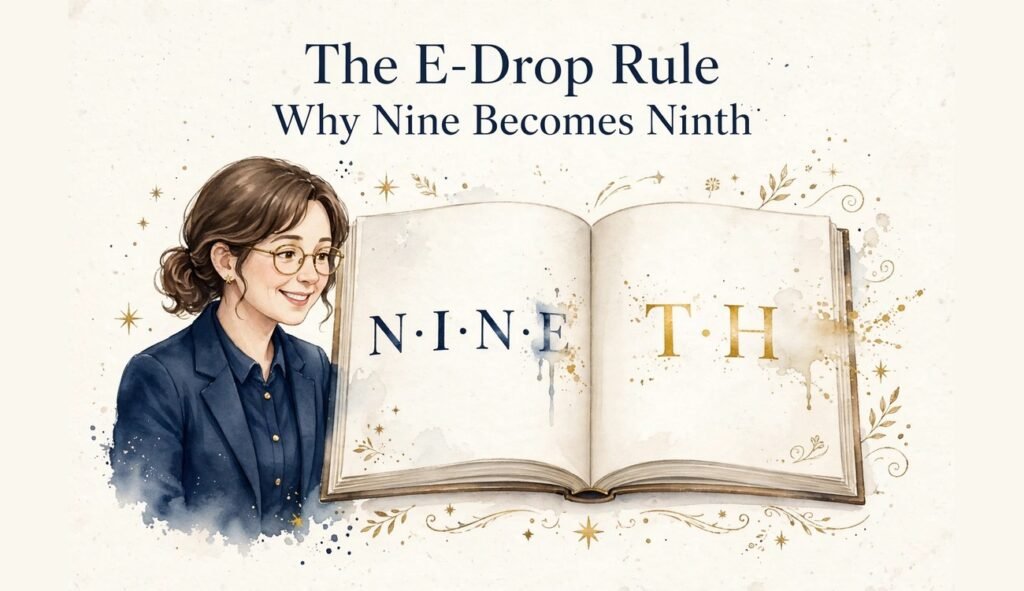
English spelling is famous for its exceptions, but the rule behind “ninth” is simple, and once you learn it, you will never need to guess again. The question of nineth or ninth is settled by one short rule: when nine takes the ordinal ending “-th”, the final E is dropped.
Nine Minus E Plus TH
The rule can be written as a tiny piece of arithmetic:
Nine − E + TH = Ninth
Start with the cardinal number nine. Remove the final E. Add the ordinal ending TH. The result is ninth. There is nothing else to it. The rule is short enough to fit on a sticky note, and it is the whole explanation for why the correct spelling has five letters instead of six.
Why Does the E Disappear?
The E disappears because of how English handles silent E at the end of words. A silent E is usually there to mark the vowel sound before it — it tells you that the I in “nine” is a long I, not a short one. But when a suffix is added, the E becomes unnecessary, and English drops it: “make” becomes “making”, “write” becomes “writing”, “hope” becomes “hoping”. The same thing happens here: nine becomes ninth because the E has no work left to do once the “-th” is added.
This is not a rule that applies to every word ending in E — English is never that tidy — but it is the pattern that explains ninth, and it is the pattern behind several other familiar spellings. Once you see it, the missing E stops looking like a mistake and starts looking like the natural result of a real rule.
The Same Rule in Other Words
Ninth is not the only word where a final E disappears before a suffix. Consider these familiar examples:
- Five becomes fifth. The V changes to F as well, but the E is gone, just as it is in ninth.
- Twelve becomes twelfth. Again, the V changes to F, and the E disappears.
- Nine becomes ninth. Only the E disappears here, which is why the change is easy to miss.
- True becomes truly. The E drops before the “-ly” ending.
- Gentle becomes gently. The E drops before the “-ly” ending.
Ninth vs Ninetieth: The One Word That Keeps the E
The most confusing cousin of ninth is ninetieth — the ordinal form of ninety — and it is the reason the question of nineth or ninth confuses so many people. These two words look alike, they come from the same root, and they are often confused. But their spellings follow different rules, and understanding the difference is the key to spelling both of them correctly.
Ninetieth Keeps the E
Ninetieth is spelled N-I-N-E-T-I-E-T-H. The E is still there, right after the N, exactly where it is in “ninety”. This is because ninetieth is formed from ninety, not from nine. Ninety ends in a Y, and the rule for words ending in Y is different: the Y changes to IE before the “-th” ending is added. Twenty becomes twentieth, thirty becomes thirtieth, forty becomes fortieth, fifty becomes fiftieth, and ninety becomes ninetieth. In all of these words, the E that appears before the TH is part of the “-ieth” ending, not the E from “nine”.
The Confusion in Real Life
The confusion shows up in real writing all the time. A student writing about “the ninetieth anniversary” will sometimes write “the ninth anniversary” by mistake, or write “nineth” because the E in ninetieth makes “nineth” feel right. A writer describing “the ninth month” might write “the ninetieth month” by accident, or the other way round. The words are close enough in sound and spelling that the brain mixes them up, especially when you are writing quickly.
The fix is to slow down and check the base word. Are you writing about the number nine, or the number ninety? If it is nine, the word is ninth, with no E. If it is ninety, the word is ninetieth, with the E. Ask the question, and the spelling follows. The same kind of one-letter confusion appears in Trainor or Trainer, where the difference between “-er” and “-or” is the difference between a real word and a mistake.
Ordinal Numbers: The Full Pattern
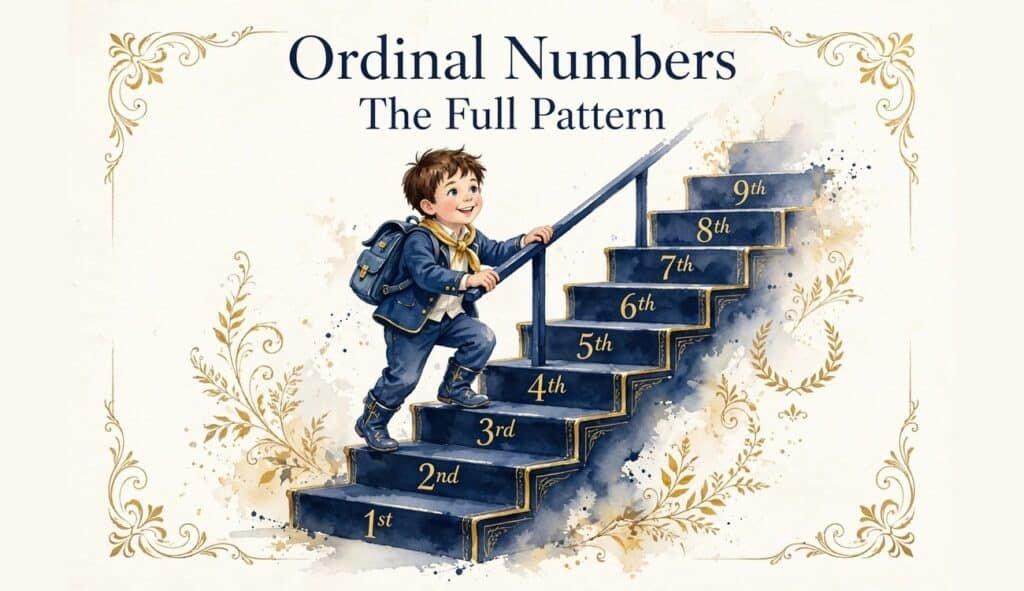
Ninth does not exist in isolation. It is one member of a family of ordinal numbers, and seeing the whole family together makes the pattern — and the exceptions — much clearer. Most ordinals are formed by adding “-th” to the cardinal number. A small group changes its spelling first. Three are completely irregular. Learn the whole table, and you will never need to guess.
| Cardinal | Ordinal | Short form | What changes |
|---|---|---|---|
| One | First | 1st | Irregular — a different word entirely |
| Two | Second | 2nd | Irregular — a different word entirely |
| Three | Third | 3rd | Irregular — a different word entirely |
| Four | Fourth | 4th | Nothing — just add -th |
| Five | Fifth | 5th | V becomes F, E drops |
| Six | Sixth | 6th | Nothing — just add -th |
| Seven | Seventh | 7th | Nothing — just add -th |
| Eight | Eighth | 8th | Only one T — eight already ends in T |
| Nine | Ninth | 9th | E drops |
| Ten | Tenth | 10th | Nothing — just add -th |
| Eleven | Eleventh | 11th | Nothing — just add -th |
| Twelve | Twelfth | 12th | V becomes F, E drops |
| Thirteen | Thirteenth | 13th | Nothing — just add -th |
| Fourteen | Fourteenth | 14th | Nothing — just add -th |
| Fifteen | Fifteenth | 15th | Five becomes fif |
| Sixteen | Sixteenth | 16th | Nothing — just add -th |
| Seventeen | Seventeenth | 17th | Nothing — just add -th |
| Eighteen | Eighteenth | 18th | Nothing — just add -th |
| Nineteen | Nineteenth | 19th | Nothing — just add -th |
| Twenty | Twentieth | 20th | Y becomes IE |
The Three Irregular Ordinals
First, second, and third are completely irregular. They do not look like the numbers they come from at all — one becomes first, two becomes second, three becomes third. There is no rule that explains them; they are simply words you have to memorise, and every English speaker does, usually in childhood. Their short forms are irregular too: 1st, 2nd, and 3rd.
The Four That Change Spelling
Only four ordinals in the first twenty change their spelling before the “-th” is added: fifth, eighth, ninth, and twelfth. Fifth and twelfth both change V to F and drop the E. Eighth drops one of its two Ts — eight already ends in T, so adding “-th” would give “eightth”, which nobody writes. Ninth drops the E. That is the whole list. Every other ordinal from four to nineteen is formed by adding “-th” to the cardinal number without changing a single letter.
The Tens: Y Becomes IE
The tens follow their own rule. Twenty becomes twentieth, thirty becomes thirtieth, forty becomes fortieth, fifty becomes fiftieth, sixty becomes sixtieth, seventy becomes seventieth, eighty becomes eightieth, and ninety becomes ninetieth. In every case, the final Y changes to IE before the “-th” is added. The rule is completely regular — it works for all eight tens without exception — and it is the reason ninetieth has an E in it while ninth does not.
The tens rule is also the reason “forty” is spelled without a U, which is a story of its own. If you have ever wondered about that one, the full explanation is in Fourty or Forty, where a single missing letter is the whole difference between right and wrong — just as it is here.
Compound Ordinals: Only the Last Word Changes
When a number has two parts, only the last part changes. Twenty-one becomes twenty-first, thirty-two becomes thirty-second, forty-five becomes forty-fifth, ninety-nine becomes ninety-ninth. The tens part stays exactly as it is, and the hyphen between the two parts stays as well. The last word follows the same rules as it does on its own: one becomes first, two becomes second, three becomes third, five becomes fifth, eight becomes eighth, nine becomes ninth.
How to Spell Ninth: A Step-by-Step Trick
Knowing the rule is one thing. Remembering it under pressure — in an exam, in a job application, in the middle of a long email — is another. Here are five memory tricks, and you only need one of them to stick. Pick the one that feels most natural to you, and use it every time until the spelling becomes automatic.
Trick 1: Nine Minus E Plus TH
Write it as a tiny sum, and say it to yourself:
Nine − E + TH = Ninth
This is the whole rule in five symbols. It works because it is visual: you can picture the E being crossed out and the TH being added. Write the sum out a few times, crossing out the E with a pen, and the picture will stay in your head.
Trick 2: The Odd One Out
Nine is an odd number, and ninth is the odd one out: the only word in the whole nine family without an E. Nineteen has an E, ninety has an E, ninetieth has an E, ninety-nine has an E — only ninth is missing it. Remember that ninth is the odd one out, and you will remember it is the one without the E.
Trick 3: Five Letters, No More
Ninth has five letters: N-I-N-T-H. If the word you have written has six letters, you have written “nineth”, and you have one letter too many. Count the letters. Five is right. Six is wrong.
Trick 5: Pair It With Eighth and Tenth
Learn ninth as part of a set of three: eighth, ninth, tenth. Say the three words together, and write them together. Eighth has six letters, ninth has five, tenth has five. Practising the three together builds a habit, and habits are stronger than rules.
Ninth in Everyday Life: Grade, Month, Place and More
Ninth is not a rare word. It appears in everyday English constantly — in schools, in calendars, in addresses, in competitions, and in conversation. Knowing how it is used in each of these contexts will help you recognise it, spell it correctly, and use it naturally.
Ninth Grade
In American schools, ninth grade is the first year of high school. Students in ninth grade are usually fourteen or fifteen years old, and they are often called freshmen. The phrase “ninth grade” appears in school reports, in college applications, and in everyday conversation about education. In British schools, the equivalent year is called Year 10, which is one reason the phrase “ninth grade” is more common in American English — but the spelling is the same on both sides of the Atlantic.
Ninth Month
The ninth month of the year is September. The name comes from the Latin word septem, meaning seven, because September was the seventh month in the old Roman calendar before January and February were added. The ninth month is also significant in pregnancy, which lasts about nine months, and the phrase “in her ninth month” is a common way of describing the final stage of a pregnancy.
Ninth Place
Ninth place means the position after eighth place and before tenth place. In a race, the runner who finishes ninth came in after eight other runners. In a competition, ninth place is often the last position that earns a prize or a mention. In a league table, the team in ninth place sits in the middle of the table — not at the top, not at the bottom, but firmly in the middle.
Ninth Floor
In buildings, the ninth floor is the floor above the eighth and below the tenth. In American English, the ground floor is usually called the first floor, so the ninth floor is eight floors above the ground. In British English, the ground floor is the ground floor, and the first floor is the one above it, so the ninth floor is nine floors above the ground. The difference is a quirk of naming, not of spelling: in both countries, the word is ninth.
Ninth in Dates, Time and History
Dates are one of the most common places where ninth appears in writing, and one of the most common places where the misspelling appears as well. Getting dates right matters, because a date is a fact, and a misspelled date looks like a careless fact.
Writing the Date
In British English, the ninth day of the month is usually written as “the 9th of May” or “9 May”. In American English, it is usually written as “May 9” or “May 9th”. In speech, both are pronounced “May ninth” or “the ninth of May”. The word is the same in all of these forms, and so is the spelling.
The Ninth of May and Other Dates
The ninth day of a month has been the date of many historical events. The ninth of May is Victory Day in Russia and several other countries, marking the end of the Second World War in Europe. The ninth of November is the date of the fall of the Berlin Wall in 1989. The ninth of September is the date of the founding of North Korea in 1948. These are all dates that appear in history books, in news articles, and in exam answers — and in every case, the word is ninth.
The Ninth Century
Centuries are counted with ordinal numbers, so the ninth century is the period from the year 801 to the year 900 — the century of Alfred the Great in England and of the Viking invasions. In history essays, “the ninth century” is a common phrase, and a common place for the misspelling to appear, because students writing quickly will write “the nineth century” without thinking.
Formal Letters and Dates
Formal letters often begin with a date written out in full: “9th May 2026” or “May 9, 2026”. In formal writing, the date is often the first thing a reader sees, and a misspelling in it sets a bad tone for the whole letter — which is why the choice of closing matters too, as explained in Faithfully or Yours Sincerely. A formal letter is judged as a whole, and every detail counts.
Ninth in Sports, Music and Culture
Beyond schools and calendars, ninth has a life in sports, music, and popular culture. These uses are worth knowing, because they are the ones you will meet in newspapers, in conversation, and in entertainment.
The Bottom of the Ninth
In baseball, the ninth inning is the last inning of the game, and “the bottom of the ninth” is the final half-inning, when the home team bats last. The phrase has become a symbol of the last chance — the moment when everything depends on what happens next. “It came down to the bottom of the ninth” means it was decided at the very last moment. The phrase is so well known that it appears in films, in songs, and in everyday speech far beyond baseball.
The Ninth Symphony
Beethoven’s Ninth Symphony is one of the most famous pieces of music ever written. Its final movement sets Schiller’s “Ode to Joy” to music, and the “Ode to Joy” has become the anthem of the European Union. The symphony is called the Ninth because it was the ninth symphony Beethoven wrote — always spelled ninth.
The Ninth in Film and Television
The Ninth Doctor is the ninth incarnation of the Doctor in the television series Doctor Who, and The Ninth Gate is a film by Roman Polanski. In all of these uses, the word is doing the same job: it marks a position in a series, and it is spelled ninth.
Common Mistakes With Ninth (and How to Fix Them)
Even people who know the rule make mistakes with ninth, and the question of nineth or ninth is the one that trips up more writers than any other ordinal. Here are the five most common errors, with the fix for each one. If you recognise any of these in your own writing, you are not alone — and the fix is simple in every case.
Mistake 1: Writing “Nineth” Instead of “Ninth”
This is the most common mistake, and it is the one this whole guide is about. The fix is the rule: nine minus E plus TH equals ninth. Write the word, count the letters, and check that there are five, not six. If you see an E between the N and the T, delete it.
Wrong: She finished nineth in the race. Right: She finished ninth in the race.
Mistake 2: Confusing Ninth With Ninetieth
Ninth is the 9th. Ninetieth is the 90th. The difference is eighty-one, and mixing them up changes the meaning completely. The fix is to check the base word: nine gives ninth, ninety gives ninetieth. If you are writing about nine things, the word is ninth. If you are writing about ninety things, the word is ninetieth.
Wrong: This is the ninetieth time I have told you. (When you mean the ninth time.) Right: This is the ninth time I have told you.
Mistake 3: Writing “9nd” or “9rd” Instead of “9th”
The short form of ninth is 9th, made from the last two letters of the word. Some writers use 9nd or 9rd by mistake, following the pattern of 2nd and 3rd. The fix is to remember that the short form follows the word, not the digit. The word is ninth, its last two letters are TH, so the short form is 9th.
Wrong: Today is the 9nd of May. Right: Today is the 9th of May.
Mistake 4: Adding an E in Compound Ordinals
In compound ordinals, only the last word changes, and it follows the same rules as it does on its own. Twenty-nine becomes twenty-ninth, not “twenty-nineth”. Ninety-nine becomes ninety-ninth, not “ninety-nineth”. The fix is the same rule, applied to the last word: nine minus E plus TH equals ninth, whether the word stands alone or at the end of a compound.
Wrong: Her twenty-nineth birthday is next week. Right: Her twenty-ninth birthday is next week.
Mistake 5: Using “Nineth” in Formal Writing
The most damaging mistake is using “nineth” where accuracy matters: a CV, a covering letter, an exam answer, a business report, a legal document. There, a misspelling signals carelessness, and it can cost you marks, interviews, or credibility. The fix is to learn the rule before you need it, and to check the word every time until the correct spelling becomes a habit.
There is a useful parallel here with other one-letter spelling questions. In Trainor or Trainer, the difference between “-er” and “-or” is the difference between a real word and a mistake, and the wrong version appears in CVs and job applications more often than anyone would like. The lesson is the same in both cases: learn the rule, build the habit, and check the word before you send the document.
A Quick Checklist Before You Send
Before you send any document that contains the word ninth, run through this checklist. It takes ten seconds, and it will save you from the most common errors:
- Does the word have five letters? If it has six, delete the E.
- Is the fourth letter T? If it is E, the spelling is wrong.
- Am I writing about nine or ninety? Nine gives ninth, ninety gives ninetieth.
- Is the short form 9th? If it ends in ND or RD, fix it.
- In a compound ordinal, is the last word spelled ninth? Check it separately.
If the answer to all five questions is yes, the spelling is correct. The checklist is short enough to memorise, and it covers every mistake in this section. Use it until you do not need it any more — and then keep using it, because habits are what survive under pressure.
The Nine Family: Ninth vs Ninetieth vs Nineteen vs Ninety
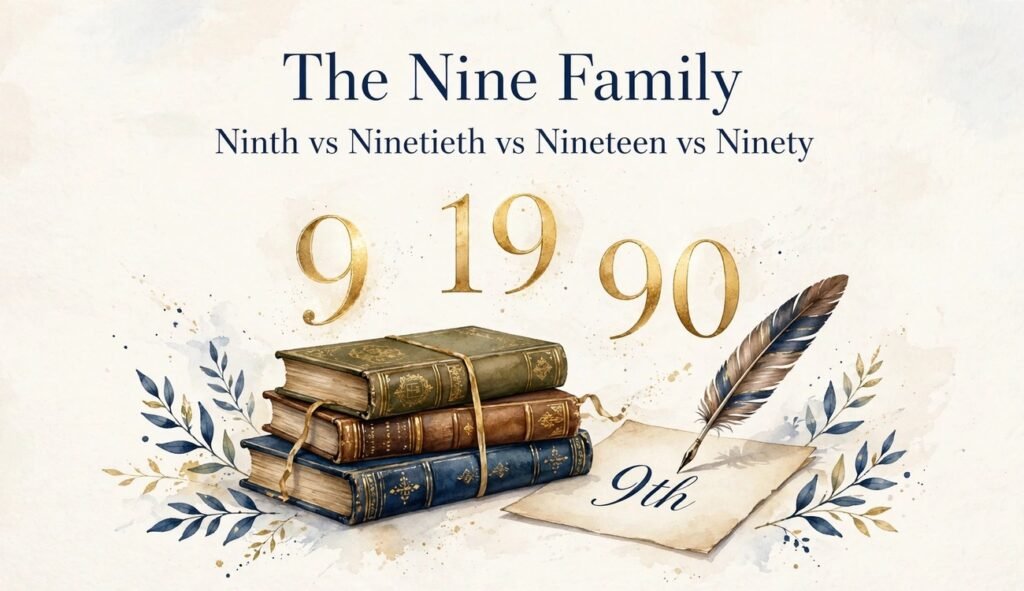
The words built from nine form a small family, and seeing them side by side is the best way to understand why ninth is spelled the way it is — and why the question of nineth or ninth keeps coming up. Every member of the family keeps the E except one. That one is ninth, and it is the odd one out.
| Word | Spelling | Letters | Has an E after N? | Meaning |
|---|---|---|---|---|
| Nine | N-I-N-E | 4 | Yes | The cardinal number 9 |
| Ninth | N-I-N-T-H | 5 | No | The ordinal number, 9th |
| Nineteen | N-I-N-E-T-E-E-N | 8 | Yes | The cardinal number 19 |
| Nineteenth | N-I-N-E-T-E-E-N-T-H | 10 | Yes | The ordinal number, 19th |
| Ninety | N-I-N-E-T-Y | 6 | Yes | The cardinal number 90 |
| Ninetieth | N-I-N-E-T-I-E-T-H | 9 | Yes | The ordinal number, 90th |
| Ninety-nine | N-I-N-E-T-Y-N-I-N-E | 10 | Yes | The cardinal number 99 |
| Ninety-ninth | N-I-N-E-T-Y-N-I-N-T-H | 12 | Yes (first part) / No (last part) | The ordinal number, 99th |
Ninth Is the Only One Without an E
Look at the table and the pattern jumps out. Nine has an E. Nineteen has an E. Ninety has an E. Ninetieth has an E. Ninety-nine has an E. Only ninth is missing it. This is not a coincidence, and it is not a mistake in the table. Ninth is the only word in the family that drops the E, and that is exactly why it is the word people misspell.
Nineteen and Ninety Keep the E
Nineteen and ninety are formed by adding a suffix to nine, but they do not drop the E. Nineteen adds “-teen”. Ninety adds “-ty”. In both cases, the E stays, because the suffix begins with a consonant that needs the E to keep the word readable, or because the pattern of the word family demands it. The details of why are less important than the fact: nineteen and ninety keep the E, and ninth does not.
Frequently Asked Questions
Is “nineth” a word?
No, “nineth” is not a word in standard English. It is a misspelling of “ninth”. No major dictionary lists it as a word of its own, and it should never be used in writing. The only correct spelling of the ordinal number is ninth, spelled N-I-N-T-H. The confusion over nineth or ninth is understandable, because “nineth” follows the usual pattern for ordinal numbers — but nine is an exception to that pattern, and the E must be dropped.
How do you spell the 9th?
The 9th is spelled ninth as a word and 9th as a short form. The word has five letters: N-I-N-T-H. The short form is made from the last two letters of the word, which is why it ends in TH. Never write “nineth” as a word, and never write “9nd” or “9rd” as a short form.
Why is it “ninth” and not “nineth”?
It is “ninth” because of the E-drop rule: when the number nine takes the ordinal ending “-th”, the final E is dropped. Nine minus E plus TH equals ninth. The E is a silent E, and it has no work left to do once the “-th” is added, so English drops it. The same thing happens in other words: five becomes fifth, twelve becomes twelfth, true becomes truly. Ninth follows the same pattern.
What is the difference between ninth and ninetieth?
Ninth is the ordinal form of nine (9th). Ninetieth is the ordinal form of ninety (90th). The difference is eighty-one. Ninth has no E after the N, because it comes from nine, which drops its E. Ninetieth has an E after the N, because it comes from ninety, where the Y changes to IE before the “-th” is added. If you are writing about nine things, the word is ninth. If you are writing about ninety things, the word is ninetieth.
Is “nineth” correct in British English?
No. “Nineth” is incorrect in every variety of English, including British English, American English, Canadian English, and Australian English. There is no regional variety in which “nineth” is the accepted spelling. The correct spelling is ninth everywhere in the English-speaking world.
How can I remember how to spell ninth?
The easiest trick is to remember that nine is an odd number and ninth is the odd one out: it is the only word in the nine family without an E. Nineteen has an E, ninety has an E, ninetieth has an E, and only ninth is missing it. Another useful trick is to count the letters: ninth has five letters, and if the word you have written has six, you have written “nineth” and you need to delete the E. A third trick is the tiny sum: nine minus E plus TH equals ninth.
Can I use “ninth” in formal writing?
Yes, “ninth” is the correct spelling for all formal writing, including essays, exams, business reports, legal documents, and job applications. It is the only correct spelling, and using it will never be marked wrong. What should be avoided in formal writing is “nineth”, which will be marked as a spelling error. The same kind of one-letter trap appears in other words too — in Verbiage vs Verbage, a single letter is the whole difference between a real word and a mistake, just as it is here.
Conclusion
The question of nineth or ninth has a short answer and a simple rule. The correct spelling is ninth — N-I-N-T-H, five letters, no E after the N. “Nineth” is a misspelling, and it should never be used in standard English. The rule behind the spelling is equally simple: when nine takes the ordinal ending “-th”, the final E is dropped. Nine minus E plus TH equals ninth.
That rule is worth learning because it is reliable. There are no exceptions to it, and there is no context in which “nineth” is correct. The E appears in almost every other word in the nine family — nineteen, ninety, ninetieth — and ninth is the only one that drops it. Remember that ninth is the odd one out, count the letters when you are unsure, and the spelling will take care of itself.
If you want to check the dictionary definition, the full entry for the word is on Merriam-Webster, which lists ninth as the ordinal form of nine and gives examples of its use as both an adjective and a noun. And if you found this guide useful, the same approach — one clear rule, plenty of examples, and a set of memory tricks — is used in our other spelling guides, where a single letter is again the whole difference between right and wrong.
Author: Emily Carter